
A hands-on worship experience
This "service" reflects a creative, hands-on engagement with A Theology of Mud, which traces elements of dust, mud, and clay throughout Scripture. It works best as a whole, but individual elements can also be used as standalone components. Inspired by Godly Play methodology, the Gospel presentation allows congregants to participate in meaning-making through wondering questions.

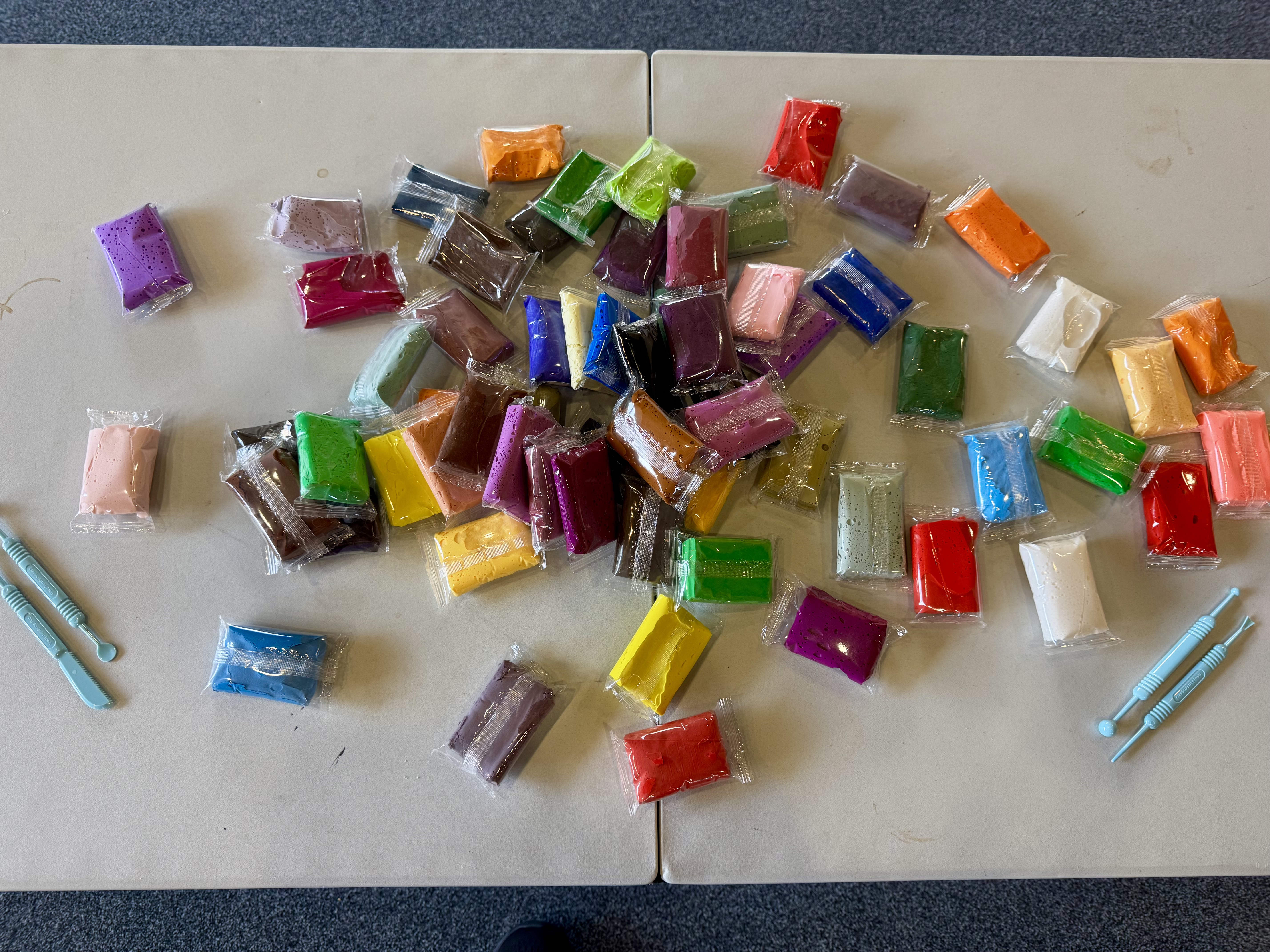
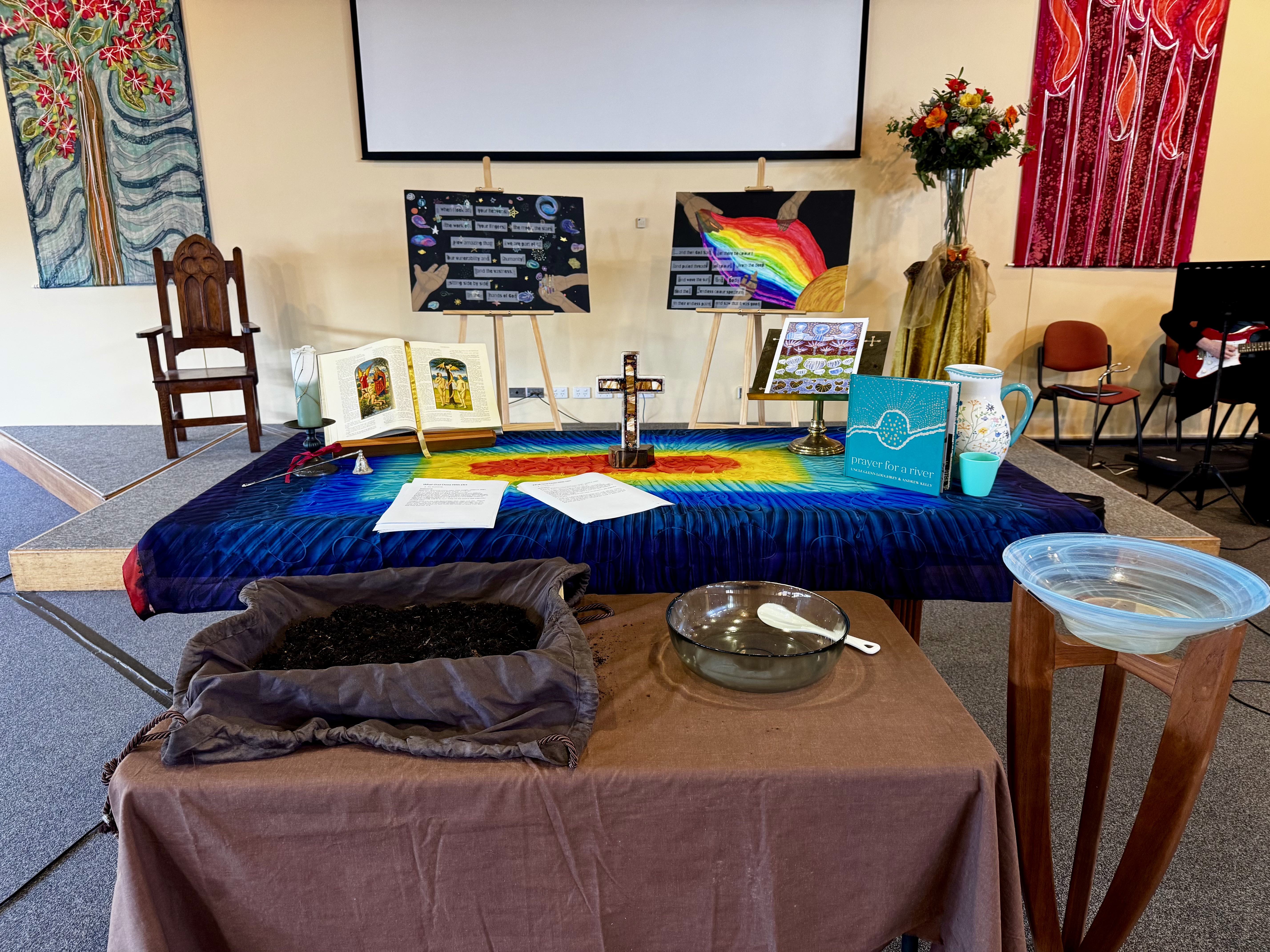
You will need a jug full of water and a big bowl; a second bowl (preferably clear); a bag or box full of soil; a clay-fired communion cup and plate OR an earthenware bowl and pieces of paper for prayer slips or muddy handprints; and some pots of air-drying clay for folk to help themselves to if they wish.
Part 1: The Gathering
Welcome
In the name of Creator God, who by creative word spoke galaxies into being, and shaped this planet with soil and salt water,
and this particular blue of sky above Awabakal Country;
in the name of Jesus Christ,
who did not descend from somewhere else but was born,
as we were, of woman’s flesh and this Earth’s own clay;
and in the name of the Holy Spirit,
the breath that still moves through forest and floodplain
and the small hidden rooms of our own becoming,
welcome to ….
Today might be a little different to what you are used to today because the whole service is the sermon, a living story, that we tell and make and enter together.
Are you ready? Then let’s begin:
“Welcome. Wherever you’ve come from today,
whatever shape you’re in,
you’re welcome here, exactly as you are.
This is a space where you get to be who you are.
You can move in and out of this room whenever you need to.
If things get a bit loud or too much, take a breath,
feel free to grab a pot of clay and make and remake with it,
or pop outside and look up for a bit.
When we come to times of conversation or reflection,
you can join in out loud, or quietly,
or just sit with it in your own head;
whatever suits your energy today.
There’s no wrong way to be here when we are kind to
and respectful of each other.
Today we’re playing with three things: earth, mud, and clay.
They’re old images.
They run right through Scripture,
right through our own lives,
and we’re going to play with all three,
to see what they teach us about God, about ourselves,
and about this world we share with dust and mud and clay in it.
Acknowledgment of Country
We begin, as we always do, on Awabakal Country – land that has been cared for, walked on, sung over, for sixty thousand years and more, long before any of us arrived here.
Before there was a garden, before there was a human shaped from the ground, there was water. There was a river….
<dramatically pour water from the jug into a bowl>
Song
Call to Worship — Genesis 2:4-7
This is the account of the heavens and the earth when they were created, when the Lord God made the earth and the heavens.
Now no shrub had yet appeared on the earth and no plant had yet sprung up, for the Lord God had not sent rain on the earth and there was no one to work the ground, but streams came up from the earth and watered the whole surface of the ground.
Then the Lord God formed a man from the dust of the ground and breathed into his nostrils the breath of life, and the man became a living being.
***
In the beginning, before the rain had fallen even once,
a stream rose up from the earth
and watered the whole face of the ground.
And God reached, I think, into wet earth,
into the mud that water makes of dust and formed a human being
(the Biblical word is not “man” but “earth being”),
and breathed into it the breath of life,
and the human became a living being.
This is where we start.
With God’s hand in our making;
with God’s breath in our being.
We are formed from this ground.
We are breathed into by this God.
Let’s begin.
Embodied breath and posture prayer
You don’t have to move for any of this.
If staying still, breathing, is what you need today,
that is exactly enough.
Everything I ask you to do, you’re also welcome to simply think,
or picture, instead of physically doing.
Let’s start with a breath. In… and out.
With your body — in whatever way feels right, as big or as small as you like — show me what your body has felt like this week. Tired. Heavy. Light. Wound tight. There’s no correct shape for this. You can use your whole body or even just a finger but take your moment.
Breathe. In… and out.
Now show me what your energy has felt like this week. Maybe it’s the same shape as before. Maybe it’s different.
Breathe. In… and out.
And now, only if it feels safe to, let your body show,
in whatever small and private or big and loud way you need,
what it looked like when something hard happened to you this week. This can be as small as a single closed hand.
No one needs to see more of it than you want to give.
Breathe. In… and out.
And now, one more breath,
and let your body settle into whatever safe feels like for you.
Open hands, if that’s true today.
Feet flat on the ground.
Shoulders down from your ears.
This is a safe space.
And you are free — free to be exactly the shape you are today.
SONG
Part 2: The Lamenting
We’ve talked about dust becoming mud when water meets it.
Lament is often where that happens in us:
where the dry, held-together parts of us get wet, get messy,
because something in us or around us needs grieving.
And so, we’re going to grieve today with the voice of Job,
a man who suffered greatly and unfairly.
Job’s Lament
You shaped me like clay,
your hands knit me together,
bone and sinew, breath and skin —
and now, will you turn me back to dust
so soon?I did not ask to be formed.
I did not ask for this precise, particular shape,
these hands, this ache,
and yet here I am,
made carefully, it seemed,
only to be unmade.Why did you bring me out of the womb at all,
if this was always where I was headed?
Why the trouble of shaping,
if crushing was the plan?I sit in the ashes of everything I had.
I scrape my own wounds
with whatever’s broken and close at hand.
My friends have explanations.
I have none that fit.I am clay,
and I am angry at the potter,
and I do not know if that’s allowed —
but I am saying it anyway,
into whatever silence is listening.
In a moment, I’m going to invite you to come forward.
You can bring a handful of dirt from the tray
to symbolise the messiness of our world,
or a cup full of water from the bowl
to symbolise the tears we so often hold back
and to let them mix and make mud with one another.
Bring with them whatever you need to lay down today.
A name. A sorrow. A worry.
You don’t have to say anything out loud.
Just let the dirt go into the water.
Instrumental Music
Part 3: The Wondering
Now we come to a story from John 9 about changing the way we see
– and I hope it might change our way of seeing the messy, muddy parts of our lives.
I’m going to tell it to you in three parts, and after each part,
I want to ask a couple of wondering questions
– which you can answer out loud or just in your head.
***
One day, as the disciples were heading home quietly after a tough day at the temple, they noticed a man who had been born blind.
The man was sitting by the road, as he had done for as long as anyone could remember.
He had never seen the road, or the sky above it, or the faces of the people who passed him every day.
He knew the world by sound and smell and touch. He knew footsteps. He knew voices. He knew when people hurried past and when they stopped.
The disciples slowed down when they saw him. They looked at the man, and then they looked at Jesus. And one of them asked a question people had asked for a very long time.
“Who sinned?” they said. “Was it this man, or was it his parents, that he was born blind?”
Jesus stopped walking. Jesus looked at the man. Jesus really saw him. And Jesus said, “Neither this man nor his parents sinned.” He said, “This is not about blame.” He said, “This is about what God is doing right now.”
the disciples’ questions
I wonder why the disciples needed someone to blame.
I wonder what it feels like to be talked about instead of talked to.
I wonder what questions we still ask today that already assume the wrong answer.
***
Then Jesus bent down. Right there on the dusty road.
He took some earth. He mixed it with his own saliva. And he made mud.
The disciples watched. The people nearby watched. The blind man could not watch. So he waited.
Jesus gently touched the man’s eyes with the mud.
Not quickly. Not roughly. Carefully. As if this moment mattered very much.
Then Jesus said, “Go. Wash in the pool of Siloam.”
So the man stood up. He felt his way along the street. He found the water. He washed the mud away. And when he opened his eyes— he could see!
He could see the shimmer of water. He could see light. He could see faces. He could see the world for the very first time.
Jesus touches the man’s eyes
I wonder what it feels like to have mud pressed onto your eyes by someone else’s hands, especially mud made with someone else’s spit. I wonder why Jesus made mud instead of just speaking healing into being.
I wonder what it’s like to be touched before you can see who is touching you.
***
People began to gather.
Some said, “Isn’t this the man who used to sit and beg?” Others said, “It can’t be him.”But the man kept saying, “It is me. I am the one.”
They asked him, “How did this happen?” And he said, “A man called Jesus made mud, put it on my eyes, and told me to wash. And now I can see.”
They took him to the religious leaders. The leaders asked many questions.
They were worried about whether any rules had been broken. They were worried about the Sabbath. They were worried about being wrong.
But the man was not worried anymore. He said, “I was blind, and now I see.”
They asked his parents. His parents were afraid. They were worried about getting into trouble. So they said, “He is our son. He was born blind. Ask him yourselves.”
And still the questions kept coming.
Finally the man said, “I don’t know all the answers. I only know this: once I was blind, and now I see.”
Later, Jesus found him again.
Jesus asked, “Do you believe?”
And the man said, “Tell me who to believe in.”
And Jesus said, “You are looking at him.”
And the man said, “Lord, I believe.”
The consequences of sight
I wonder why seeing more clearly got the man into more trouble, not less.
I wonder what it cost his parents to stay silent.
I wonder who around us is still waiting for someone to see them and stand with them.
A brief reflection
Somewhere along the way,
most of us stopped playing in the mud.
We were told it was dirty.
We were told we’d get dirty.
We were told to stay clean —
clean enough to go to the shops,
clean enough to come to church.
And there’s something deep down in many of us that still believes that: that God prefers us clean, and finished, and presentable.
That holiness means staying out of the mess.
But this story says something else entirely.
It says God knelt down into the exact same undignified, unhygienic, unfinished stuff we’ve been told to stay away from
for too long and did God’s best work with it.
Not despite the mess. IN the mess.
With hands that weren’t afraid to get dirty.
So I’ve been thinking ….
Maybe the mud we’ve been told to grow out of is exactly the material God is still working with right now.
Maybe this story reminds us as followers of Jesus that the question worth asking is never: who sinned? But where is God working in mud and spit? And have we gotten too clean to get our hands dirty for the sake of changing someone else’s whole reality?
SONG
Part 4: The Responding (Communion)
We believe that God creates all things,
renews all things
and celebrates all things.
It is at this table that we are reminded that God,
in Jesus, became an Earth-being
who lived and breathed and spoke among us,
that this sacred planet may be filled with the Spirit’s presence and be renewed as home for us and all our kin.
So we come to this table, not to get clean,
but to get our hands into something real.
This is where the dust of the earth becomes a people,
where clay becomes a cup.
where mud, once again, becomes a means of healing.
The Lord be with you.
And also with you.
Lift up your hearts.
We lift them to the God of all creation.
Let us give thanks to the Lord our God.
It is right to give our thanks and praise.
It is right, and more than right,
to give you thanks always and everywhere,
God of galaxies and garden soil.
You spoke,
and the Earth rose out of formlessness into living mystery;
you shaped mountains the way a potter shapes clay;
unhurried, you set boundaries for the skies and seas.
You made us from this planet’s own mud
and breathed into us the same breath
that moves through forest and reef
and the deep places of the sea,
that we might praise you,
and tend the garden of your making, and remember that we were never separate from it.
And when we could not see you clearly,
you knelt down again –
mixed dust with water,
the way you did at the beginning,
and opened blind eyes with your own hands,
in the dirt, on a road, in front of everyone.
And so, with the mountains that still skip like rams
and the hills that dance like lambs,
with the whole trembling Earth that answers your presence before we do,
and with the whole communion of heaven,
we praise your name and add our voice to their unending hymn:
Holy, holy, holy:
Earth is filled with God’s presence.
Holy are you, and holy is Jesus Christ, your Word made flesh:
a particular piece of this Earth,
born and breathing and eventually broken,
who lived among us and suffered and died,
and who rose to draw all things, however messy,
back toward you.
On the night he was betrayed, he took bread of the earth,
gave thanks, broke it, and gave it to his disciples, saying:
“Take, eat; this is my body, given for you.
Do this in remembrance of me.”
In the same way, after supper, he took the cup, gave thanks,
and gave it to them, saying:
“Drink from this, all of you; this is my blood of the new covenant, poured out for you and for many for the forgiveness of sin.
Do this, as often as you drink it, in remembrance of me.”
So we proclaim together the mystery of faith:
Christ has died.
Christ is risen.
Christ will come again.
Lord Jesus, you are the potter
and we are the clay.
You do not discard what is cracked,
nor turn away from what is unfinished.
You work patiently with what you have made,
shaping vessels of love and mercy
from the ordinary matter of our lives.
You have entrusted your treasure
into these jars of clay:
your light in fragile bodies,
your love in imperfect hands,
your Spirit in people
who are still becoming.
So, pour out your Spirit, O God,
on this bread and this cup,
that they may become for us the body and blood of Christ;
and pour out that same Spirit on us, unfinished as we are,
that we might become for the Earth
something like the hands and heart of Jesus,
unafraid to get dirty for someone else’s sake,
until the day Christ comes to gather every shard of creation
and shape it, whole, into your glory.
Breaking of the Bread
This is the bread of Earth,
grown in soil, gathered by human hands,
and broken as Christ was broken open.
This is the cup of Christ,
like us a fragile vessel,
carrying a holy treasure.
We are one body, one Earth, one fragile hope.
Communion is shared
Part 4: The Responding (Creative)
So today we’re going to get our hands dirty through three options:
One – take a slip of paper. Write a prayer request on it, as much or as little as you want, with your name or without it. Fold it, and place it in the earthenware bowl.
Two – take a piece of clay. Shape it into whatever you need to. Then unshape it, and shape it again, as many times as you like. There’s no final form you have to reach. Just the shaping, and the reshaping, and the God who’s in both.
Three – if you’d rather be outside, take the bowl of mud into the garden. Play with it properly. When you’re done, leave your muddy handprint on a piece of paper.
Part 5: The sending
God of the earth and mud and clay,
you have met us on this ground,
in the ordinary matter of the Earth:
in grain and grape,
in clay and water,
in bodies that hunger,
and hearts that long to be made whole.
We thank you
that you do not wait for us to be clean,
finished, or presentable.
You meet us in the mud.
You work with what is broken.
You place your treasure in jars of clay.
Send us out from this time
as people willing to get our hands dirty
for the sake of healing.
Teach us to love the ground beneath our feet
as fiercely as we love the neighbour beside us.
And when the work is unfinished,
or we feel too fragile to carry your love,
remind us:
we are still clay in your hands,
still vessels of your Spirit,
still part of the living story
you are making in the world.
Until the whole Earth becomes,
slowly and against the odds,
the sanctuary you made it to be
from the beginning.
May the Spirit of God,
who is above all and in all and moving through all things,
fill you with the knowledge of God’s presence in this Earth,
and with the heartbeat of Christ still beating, somehow,
within you, go in peace. Amen.


Leave a Reply