
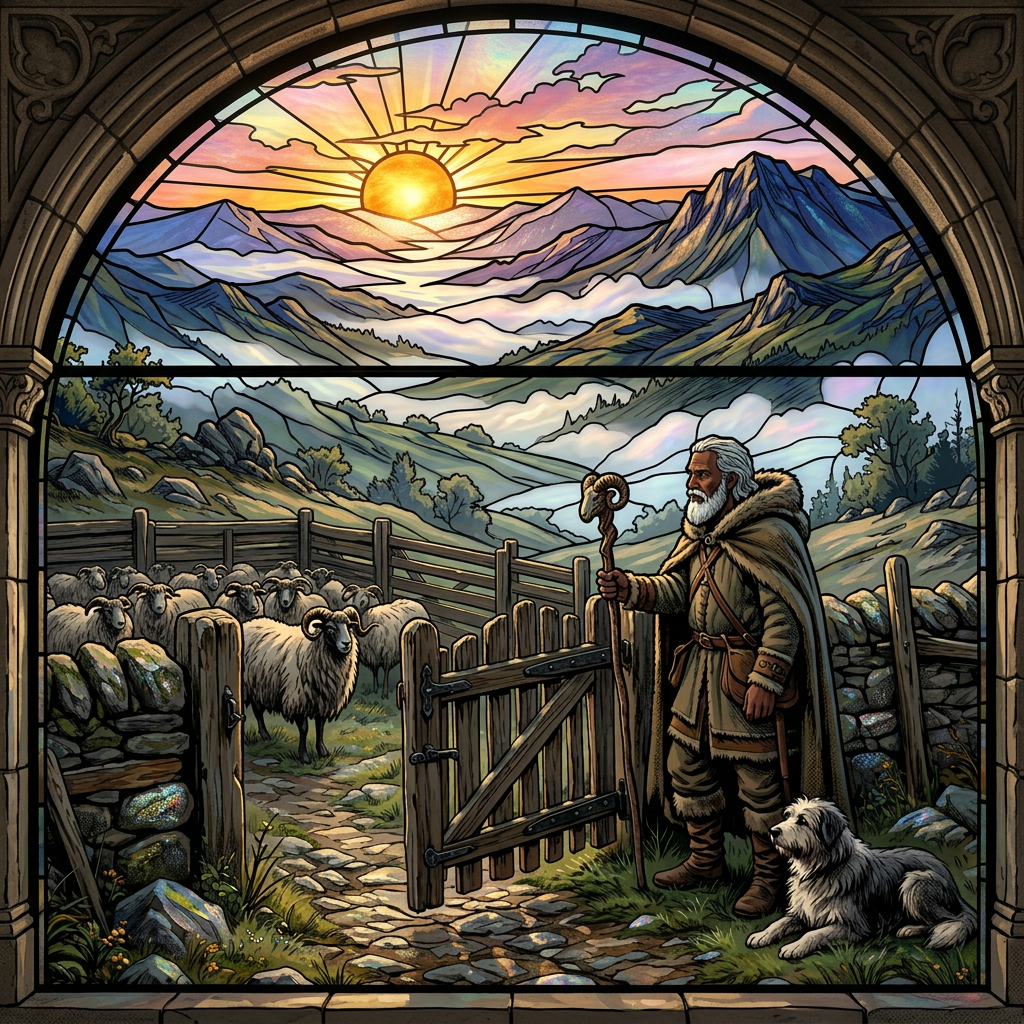
A “safeguarding” service for our intergenerational Faith@5 gathering,
because:
1. an ethic of care is about theology, not compliance;
2. so many people have experienced significant trauma through what has happened within Christian communities;
3. the Church can be a much-needed sanctuary in the midst of the chaos and unkindness in the world right now but it requires intentionality.
Gathering: The God who shelters
Scripture is full of images of God’s sheltering love:
who gathers us in from the open country
and leads us beside still waters;
who searches for the lost and carries the weary;
who stays awake when wolves come near;
who calls each one by name, and we learn his voice.
who is a refuge from the storm
and a safe place in the heat of the day;
who comforts us as a mother comforts her child—
holding us close until our breathing steadies,
and we know we belong.
Today, as we explore the theme “Sanctuary”,
we listen for Jesus’ words about sheep, shepherds, thieves and gates.
Some of what we are naming today can feel awkward to say out loud.
We might worry about spoiling the mood,
offending someone,
or opening up stories we don’t know how to hold.
But when a community becomes uncomfortable with truth,
silence can start to do the dangerous work for us:
creating a culture of secrecy,
where harm hides
and those who need help feel they must carry it alone.
So we practise a different way:
gentle, honest, and shared.
We speak clearly without panic;
we listen without prying;
and we make room for every age to learn what safety looks like
in the light of Christ.
We receive again the invitation to find
in this time, in this place, in these people
the shelter of God who restores our souls
and shapes us into a community that is God-honouring,
life-giving, and safe –
where welcome is real,
where power is handled with care,
and where harm is named and prevented, together.
Entering the Sheepfold: A participatory welcome
Leader places two chairs at the front (or centre) to form a simple “gate”. Explain: In John 10, Jesus speaks of a sheepfold: there is a gate, and there are voices we trust and voices we do not. Today we practise a welcome that is both open and wise.
Christ is our gate.
Through him we come in and find pasture.
In Christ we are welcomed,
and in Christ we learn to keep one another safe.
In this space, you may join in as you wish:
you can sing or be still;
you can speak or listen;
you can step in or step back.
You can always ask for help.
We will listen for each other’s voices.
We will respect bodies and boundaries.
We will tell the truth with kindness.
We will make room for every age.
We will not ignore harm.
Shepherding God, tune our ears to your voice
and teach us to be a sanctuary for one another.
Amen.
Exploration: The “Gate Game”
Using the two chairs as a “gate” with a clear pathway through the middle. One by one (or family by family), invite people to walk through. As each person enters, they say out loud: (1) something they hope to find in a safe place; and (2) something they want to keep on the outside. Leaders model first. Keep it short and simple; passing is always OK.
Leader models:
“As I enter, I’m looking for peace. I’m leaving outside shame.”
Then each person who wants to participate:
“I’m looking for ……………………………. I’m leaving outside ……………………………..”
PRAYER (adapted from S. Noon & H. Brokering)
Sheltering God,
show us the signs of welcome in our worship.
Help us stand together,
turn toward each other,
sing in harmony,
eat the same bread,
kneel side by side,
wave,
meet another’s eyes,
recognise a voice,
say a name by heart,
speak in unison,
intercede for each other,
give thanks,
hear the same readings,
hug,
and join in a three-fold amen.
Jesus, our Gate, hold open the way into life.
Teach us to guard what is precious,
to welcome what is tender,
and to turn away what harms.
Make our church a sanctuary. Amen.
Settling into Scripture
As the people prepare to listen to the Gospel reading for the day, they are invited to think about what it means to be a safe church by completing different acronyms (gate, voice, sheep, safe, fold, pasture) with appropriate words and/or phrases. The following example can be displayed on a board or projector:
Caring community
Headed by Jesus Christ
Us
Real people with really joys and struggles
Called to be salt and light
Hope for reconciliation
Time should be given for groups to share their responses.
Gospel Reading: John 10:1–10 (easy-to-hear)
Jesus said: “Truly, truly, I tell you:
anyone who does not enter the sheepfold by the gate,
but climbs in by another way, is a thief and a bandit.”
“The one who enters by the gate is the shepherd of the sheep.
The gatekeeper opens the gate for him,
and the sheep hear his voice.
He calls his own sheep by name and leads them out.”
“When he has brought out all his own, he goes ahead of them,
and the sheep follow him because they know his voice.
They will not follow a stranger, but they will run from him
because they do not know the voice of strangers.”
Jesus used this figure of speech with them,
but they did not understand what he was saying to them.
So again Jesus said to them,
“Truly, truly, I tell you, I am the gate for the sheep.
All who came before me are thieves and bandits;
but the sheep did not listen to them.
I am the gate.
Whoever enters by me will be saved,
and will come in and go out and find pasture.”
The thief comes only to steal and kill and destroy.
I came that they may have life,
and have it abundantly.”
This is the Gospel of the Lord.
Praise to you, Lord Jesus Christ.
Wondering together
- I wonder who the thieves and bandits might be?
- I wonder how we learn to recognise the Shepherd’s voice in our community?
- I wonder what it could look like for our church to be “the gate”—a clear, safe way in and out for everyone?
- I wonder what “life in all its fullness” might feel like here, especially for those who are most vulnerable?
Group share-back (2 minutes each, optional): Invite each table to offer one sentence beginning “For us, sanctuary might look like…” Encourage no personal disclosures; speak in general terms.
Reflection scaffold
Jesus names something we often wish we did not have to talk about:
some voices that lead toward life,
and some voices steal, kill, and destroy.
And if we are honest, even good people can feel a tightening in the chest when these things are mentioned because we have learned that polite silence feels safer than the difficult truth that church can be a place where harm is done. But the Gospel invites us into the light where love can be practised with wisdom.
Sanctuary is not only about comfort;
it is also about truth, boundaries, and shared responsibility.
In a safe church, we learn to recognise the voice of Jesus
in the way we treat one another
—especially the most vulnerable.
We learn that care is not secrecy.
We do not ask children to keep grown-up secrets.
We do not ask teenagers to carry burdens alone.
We do not ask adults to “be strong” and stay silent.
And we do not ask leaders to overlook warning signs
for the sake of peace.
We also learn that not every way “in” is loving:
secrecy, pressure, manipulation, and misuse of power
do not belong in Christ’s fold.
When something depends on silence
– when someone is isolated, rushed, flattered, or frightened –
that is not the Shepherd’s voice.
Being “the gate” is not about keeping people out;
it is about making the way into the community clear and safe
so that children, young people, adults, and leaders know:
who to talk to,
how to ask for help,
and what will happen if something unsafe occurs.
It means our welcome has shape:
it has policies, practices, and people who will respond.
Because Jesus came so that people may have life, abundant life,
we take seriously the work of becoming sanctuary.
This is worship, and it is also practice:
what we do together so that love is more than words.
So today we ask for ears to hear what gives life,
courage to name what harms,
and tenderness toward one another as we learn.
Step by step, across generations,
we become a people who can tell the truth,
ask for help,
and make it safer for the next person to walk through the gate.
PRAYERS FOR OTHERS: SHEEP AND SHEPHERDS
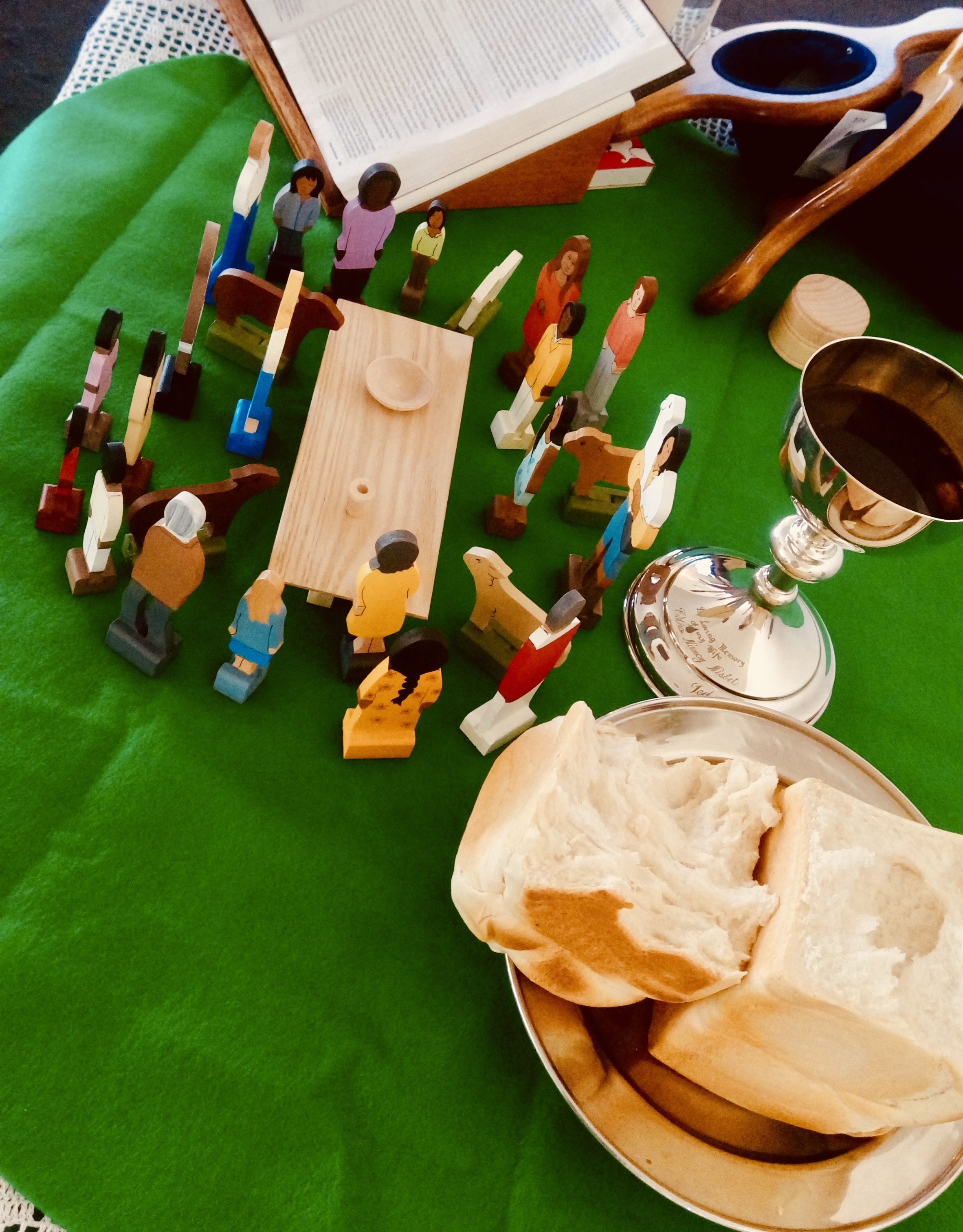
I offered this as a time of silent, embodied prayer by setting up all the people and sheep from the Godly Play “World Communion Sunday” set on one side of the communion table. On the other side, I place a large green felt circle to represent the green pastures, a sheepfold with an open gate as a place of protection, and a table set with a cup and plate as symbols of reconciliation and replenishment. People were ivited to come up if they had a particular person or situation they wanted to pray for, the pick one of the characters, and to place them where they thought they needed to be.


Leave a Reply