
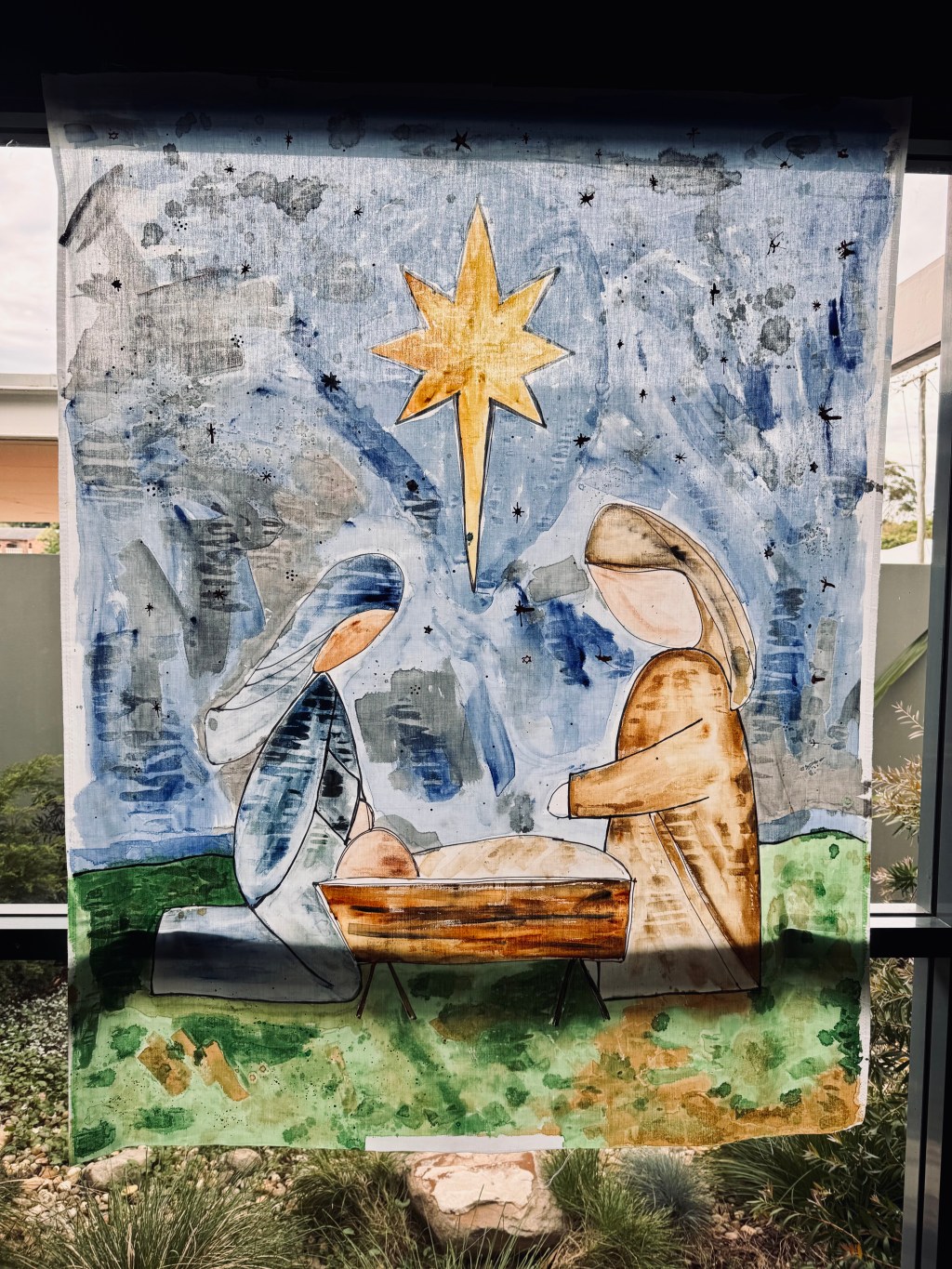
An Advent series based on the notions of simplicity, stability (a Benedictine vow), and sanctuary
Each week, congregants are offered a liturgy booklet that follows the same format and rituals, with elements like the poem/prayer, Bible reading, and wondering questions changing. The sermons are inspired by the “living stories” method and involve an unfolding visual scene that participants are able to interact with through wondering, touch, and silent reflection after.
Here is the liturgy booklet for week one, which focuses on Mary and Joseph and the theme “Open Doors.”
The text for the “living story sermon” is below with photos displaying the materials I will be using and instructions in red. Wondering questions are in bold and people should be encouraged to respond or reflect together.
The table is set with a stable on the right and a black felt underlay rolled up beside it. The doors are closed and figures representing Mary and Joseph and the baby Jesus stand in front of them.
“Listen to the story with your ears, your eyes, and your heart,
and if you want to see or hear better, come close
and help everyone to participate.”
I wonder how far back we have to go to understand this story …
which beginning makes the most sense for this new beginning:
Mary, Joseph, a newborn baby sheltering in a stable,
far from family and friends ….
Roll the cloth out fully to the right until it comes to the end of the table.
In the beginning, God created the heavens and the earth.
The earth was without form and void,
and darkness was over the face of the deep.
And the Spirit of God was hovering over the face of the waters.
And God said, “Let there be light,”
and there was light.
And God saw that the light was good.
And God separated the light from the darkness.
(Light/dark card is laid down)
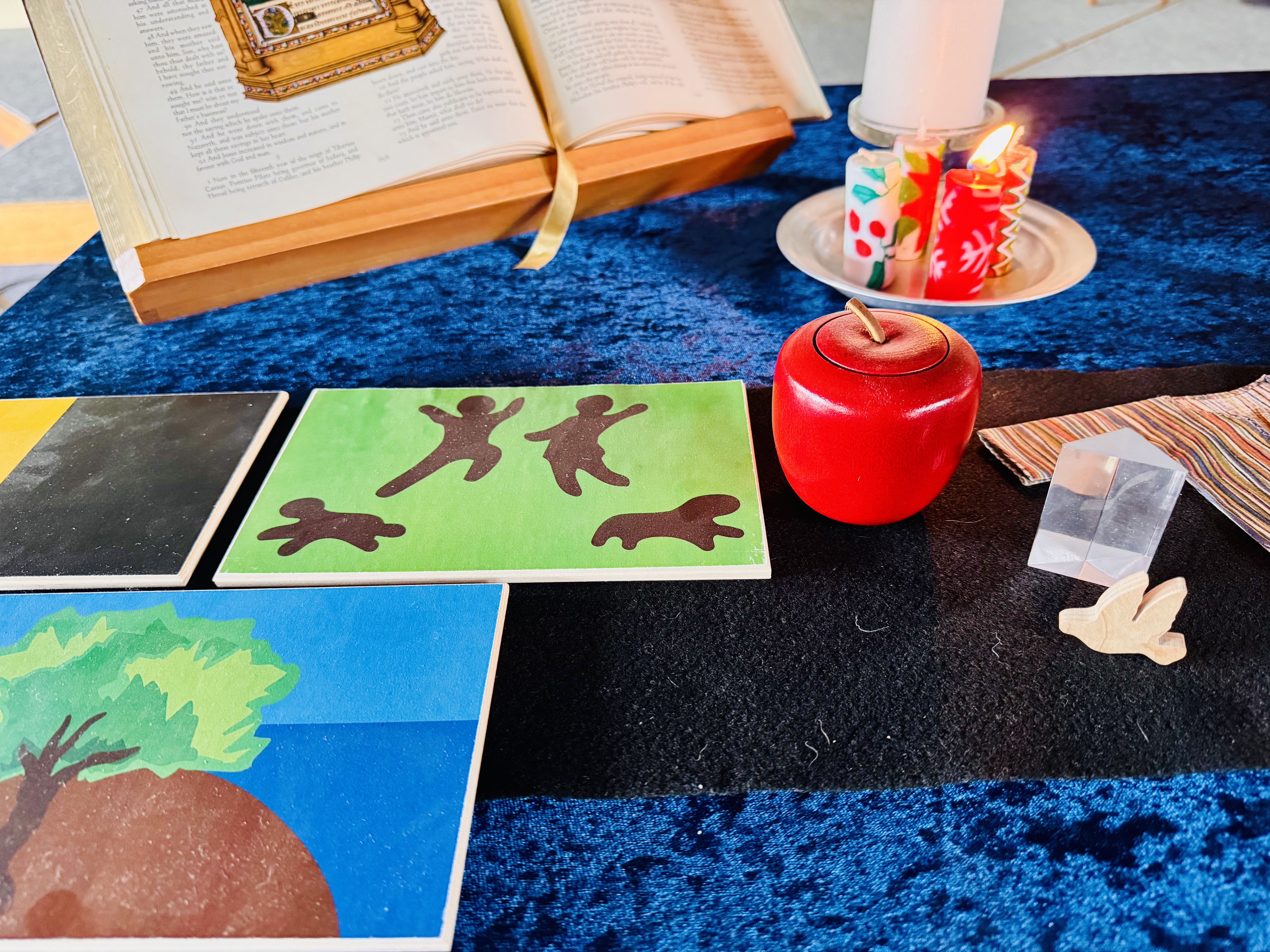
In the Gospel of Luke, Jesus’s family tree (bush/sea card is laid down)
traces all the way back to that beginning,
to Adam (creatures card is laid down), in the garden,
to the grasping for godlike power (apple is laid down),
to the darkness of shame
and of broken relationships:
between Noah and his sons (dove and rainbow prism are laid down)…
and Jacob and his sons (coat of many colours is laid down)…
and David and his sons (crown is laid down) …
and so many fathers and sons in between them ….

Until, Joseph (Joseph is moved in front of the symbols),
the son of Heli,
the son of Matthat,
the son of Levi,
all sons of the house and line of David
which included the neglected Tamar,
the prostitute, Rahab,
the foreigner, Ruth,
and the stolen bride, Bathsheba
(statue of women and children is laid down and Mary placed with them),
was forced to travel with his young bride, Miriam or Mary,
to Bethlehem (Bethlehm cutout is placed with unlit candle inside it),
a small town of no real significance in the Roman world.
In the darkness
of subjugation,
of imperial control and unjust taxation,
of daily realities shaped by bureaucratic decisions
and distant rulers,
of festering resentment
and whispers of revolt,
of mandatory travel to an ancestral town which was far from home
in the vulnerable state of advanced pregnancy,
of economic uncertainty,
of “no room” and closed doors and an unattended birth,
a child is born.
(Mary and Joseph move into the stable where the doors are now opened
to reveal a manger in which Jesus is laid).

I wonder what it was like for Jesus to be laid in a manger,
surrounded by strangers and animals
instead of family or friends.
In the beginning was the Word,
and the Word was with God,
and the Word was God.
Through the Word, all things came to be:
Jesus is the life, the light, of all people.
Even now, the light shines in the darkness,
and the darkness cannot put it out.
(Light the candle inside Bethlehem)

(Point to Joseph, Mary, Jesus and the whole stable in turn)
Joseph, a line both noble and humble;
Mary, a symbol of the openness of God’s story
to the unexpected and the overlooked;
Jesus, the light of God’s goodness enfleshed
where it is needed most –
in the darkness,
on the outskirts,
in a place of rejection and vulnerability ….
and so history becomes theology,
genealogy becomes Incarnation.
In the darkness of a world marked by exclusion,
God’s light breaks through.
The stable becomes a new creation,
echoing the beginning of Genesis: “Let there be light.”
Here, the Word becomes flesh—not in a palace,
but in the humility of an open door to all who seek hope.
I wonder how the people of Bethlehem responded
when they saw a young family in need of help
and a place to stay.
Here a community will gather,
of shepherds from the fields,
and angels in heaven,
and seekers from afar …
as we gather now.
Those living in darkness.
Those longing for light.
Those comforted by a familiar story.
Those needing a new beginning.
I wonder what hopes and dreams Mary and Joseph
had for their newborn child as they welcomed him
into the world.
Touch the wooden figures.
Feel the felt underlay.
Open and close the doors.
What is God inviting you to open today?
May this story shape not just our understanding,
but our hearts and our actions—
keeping doors open for hope, healing,
and the coming of Christ among us.
 Liturgies 4life
Leave a comment