
Watch the Triune face
give three-fold shape to our faith:
ev’ry day is grace.
Last week, I shared on my Substack how I was wrestling with the purpose of my preaching at the moment and how identifying the purpose of it within this current season of my life would likely necessitate a change in the actual how of my preaching.
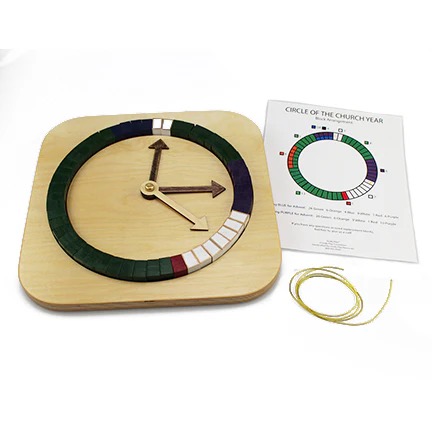
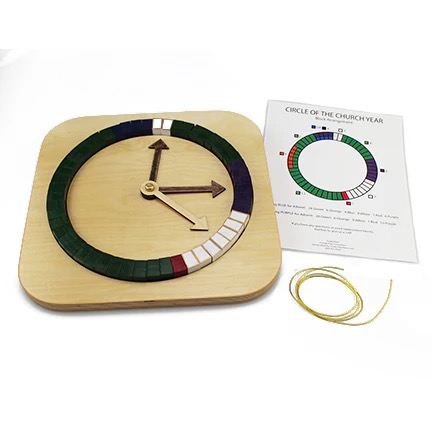
I share here today the base text for my reflection on Trinity Sunday based on Romans 5:1-5 (the Message paraphrase) and Proverbs 8 – using the Godly Play wheel of the year as a visual symbol of my words, wondering questions to prompt self-reflection, a micro-practice for the week ahead, and a haiku as summary of what I am saying.
The “end”:
- to orient ourselves to the changing seasons of the liturgical year,
- to engage in self-reflection around the current state of our lives,
- to provide a short overview of the doctine of the Trinity with an emphasis on its implications for our day to day living,
- to name the guilt and shame we often feel when our intentions of living out Christian values are not realised in the midst of our busy lives,
- to express the soul’s longing for delight and wonder and play,
- and to offer a concrete symbol that will encourage moments of reflection on the Divine in the days beyond Sunday worship.
I wonder if it has meaning for you?
We stand on the threshold of Ordinary time. Our use of the English language implies that as the liturgical clock ticks over into this new season, represented, as you will see next week, by the colour green, that we are entering into the mundane, the average. And, with the long nights and cold days right now, it might, in fact, feel just like that.
But “Ordinary Time” actually comes from the Latin “ordinalis,” the ordering of the weeks that aren’t part of the major seasons like Lent, Eastertide, or Advent into a neatly numbered sequence that stretches, well, all the way through mid-June until the end of November.
<Reveal the Wheel of the Church Year and highlight the green blocks that follow Pentecost>
Twenty Sundays focused on the public ministry of Jesus – his sermons, his miracles, and his parables in particular. Most of these reveal something about God’s presence and activity in the world in terms like “reign” or “realm” or “kingdom” and, as Christians, we are challenged in this time to deepen our understanding of what God is up to all around us, even now, so that we might share in that divine work of renewal and reconciliation and re-creation by living out those kingdom values of love and justice and forgiveness in our everyday lives.
God in our everyday lives … our unpredictable, expectation-laden, confusingly interconnected every day lives in which it’s sometimes a miracle that we make it through the day without killing anyone … and now I want to talk to you about intentionally sharing in God’s great big dream for the world as well ….
<Shake the wheel so that the individual blocks scatter and fall out of place>
And, yes, we are going to do that because, as our confirmees reminded me recently, our Christian beliefs mean very little if they are not expressed in action.
But, first, I want you to stop and take stock for a moment through this question: what is ordering your life at present? You don’t have to share that answer with anyone else – for yourself, take a moment to think about the priorities, the activities, the plans, the emotions, the fears, the relationships that are ordering your life at present?
<repack the wheel as people consider their answers>
Gordon MacDonald, author of “Ordering Your Private World” writes that:
“Most of us spend our lives mastering the art of managing our outward world, but neglect the inner world where our character and spiritual health are really shaped.”
When I read it back in my thirties as a full-time teacher, part-time student, mom to two “tween” boys, and weekend preacher, pastor, and youth worker, it, frankly, failed to nurture in me a vibrant inner devotional life that would sustain my frenetic and very other-oriented external life. It merely compounded the sense of guilt and shame that I wasn’t prioritising God and “getting it right.” And that sense still lurks just below the surface, discouraging me from frequent self-reflection ….
Yet my soul longs to “throw open the doors to God and find that God has already thrown open his door to us.” I want to find myself standing today in “the wide open spaces of grace and glory”, full of wonder and gratitude and praise. I want to hear Wisdom standing at the crossroads and calling out “come and play” in this beautiful world, inhabited by curious creatures and by people who wear God’s face. I want to know, to KNOW, that when I’m hemmed in by trouble, it’s not the all or the end of my story but that I will resist, persist, adapt, endure, and push through to what is coming next.
What do you long for? As you consider what is ordering your life right now—your priorities, fears, relationships—imagine the wheel of your year, wrapped in that golden thread. What is the thread/the guide/the gift that keeps you reaching for more in your relationship with God and with others?
<as people consider their response, wrap a golden thread around the circle>
Let’s circle back. It’s interesting, isn’t it, that this ordering of ordinary time starts with the only Sunday in the Church Year that is dedicated to a church doctrine? And it’s perplexing that you’re more likely to find the name “Trinity” in the Matrix film franchise than you are in the Bible.
Yet, in the wheel of the Church Year, Trinity Sunday signifies a shift in focus from the mysteries of Christ’s birth, death, resurrection, and ascension to a Pentecost-fuelled engagement with the ongoing life and mission of the Church in the world. Here, faith becomes lived out through service, witness, and active participation in God’s ongoing work in the world. But it’s not because we resolve to get our acts together (pardon the pun) and do better!
This Sunday, Trinity Sunday, orients us to the foundational belief of the Christian Church developed over centuries through theological reflection and Scripture interpretation that God exists as one Being in three persons: the Father, the Son (Jesus Christ), and the Holy Spirit. Each Person is fully and equally God, sharing the same divine essence, yet they are distinct in their relationships and roles.
The Trinity reveals God’s nature as love and community, with the Father bringing all our life into being, the Son restoring our relationship with the divine as our desires and choices have damaged the world and others in it, and the Holy Spirit guiding us so that we may grow more fully in our capacity to really, truly, freely love.
Unity, diversity, and relationship: this is what Trinity makes space for – in our understanding, in our ordering, in our imagining the world that God longs for us to inhabit.
The unity of the Godhead encourages us to seek harmony and cooperation, recognising that our true strength and identity are rooted in our relationship with God and one another. It reminds us that our faith is not just about individual belief, but about being part of a communal life where differences are united in love.
The distinctiveness of each Person is a valuing of different gifts, perspectives, and roles that enrich a shared life. It calls us to appreciate the variety of ways God works in the world and in us, fostering inclusion, respect, and humility.
The dynamic, loving communion among the Father, Son, and Spirit shows us that being in relationship with others is fundamental to human life and faith. We nurture connections built on love, trust, forgiveness, and respect when we imitate this divine relationship.
What would it mean to put one, or all, of these – unity, diversity, and relationship – at the centre of your life this week? How would you do that practically?
<as people consider their response, display the Wheel of the year on the communion table or altar along with a large wall clock>
I’m going to challenge you to try something this week – if you have an old-fashioned watch, wear it; if you have a smart watch, change it to an analog face; if you have a wall clock, make sure it’s in a prominent place.
And watch it – not as a measure of where you need to be next or how long you have to go until something boring or annoying or unwanted comes to an end – but as Trinity calling you to life through unity, diversity, relationship; as the Wisdom of this wondering time inviting you in your every day to find a moment of play or delight in the world and the people around you.
Watch the Triune face
give three-fold shape to our faith:
ev’ry day is grace.
 Liturgies 4life
Leave a comment